
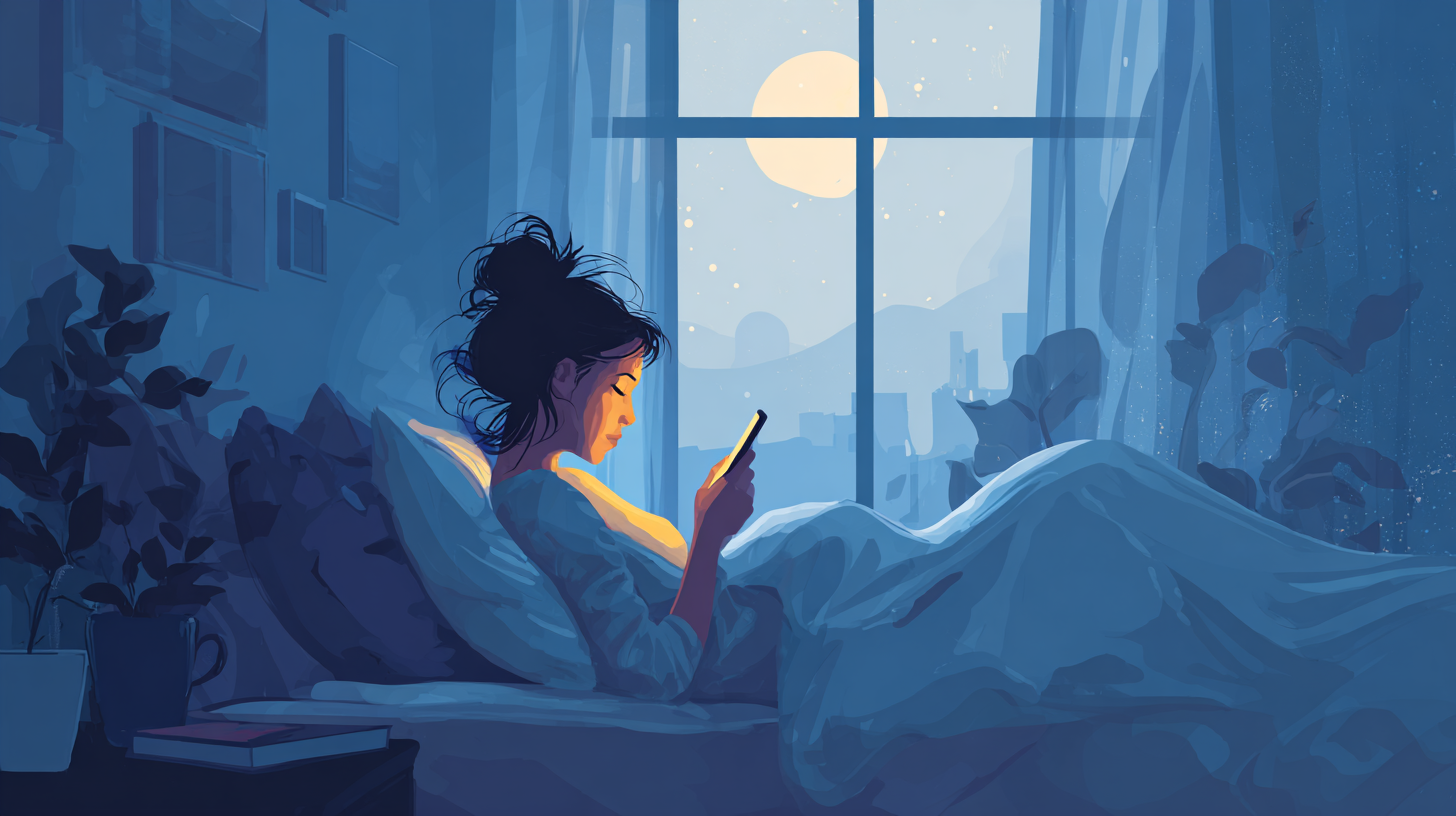
It's after 1 AM. You told yourself you wouldn't spend the night doom-scrolling, but here you are. Now you're watching a stranger talk about pasta water on social media. You have no idea how you ended up on this video. You calculate how many hours of sleep you have left before your alarm. Then, you realize tonight's sleep won't be good.
You know that late-night scrolling is bad for your sleep and your health. Maybe you tried putting your phone in another room when it's time for bed, but it probably didn't last.
When you scroll through your phone late at night, it affects several systems in your brain.
This article will explain the effects of late-night scrolling. It will show why willpower alone often isn't enough to stop it. It will also share some tips to help you beat scrolling at night.
Effect 1: Your Phone Is a Dopamine Slot Machine
In the 1950s, neuroscientist James Olds discovered something unusual in rat brains. He found a small area that, when stimulated, made rats press a lever for hours. They ignored food, water, and even sleep. This is the brain's reward system, and it runs on dopamine.
We've learned that dopamine is more about expecting pleasure than actually feeling it. For example, when you check for a notification, your brain releases dopamine. It's not the act of reading the notification that causes this, but the excitement of waiting to see what it is. This anticipation, like the thrill of the hunt, is what really triggers the release of dopamine.
This is the idea that variable reward systems take advantage of. Slot machines work because you never know when you'll win. Social feeds work because you're never sure what you'll see next. Infinite scrolling works because there's always something more to see. Each time you don't know what's coming, you get a small burst of dopamine. With enough of these bursts, your brain starts to crave more, and it gets stuck in a loop.
Why this is catastrophic at bedtime
Sleep onset requires the opposite of all this. Your cortisol levels need to drop. Your parasympathetic nervous system, known as the "rest and digest" side, can then take over. This happens after the sympathetic "fight or flight" side is less active. Your reward system also needs to quiet down.
Scrolling through your phone at bedtime does not help – it keeps your dopamine system awake when your brain needs to relax.
The result is a brain that gets stuck in the wrong gear. Your nervous system can't relax when your reward system is still looking for the next thrill. It takes longer to fall asleep, and the sleep you get is not as deep. Even when you put your phone down, your brain stays active. The excitement lingers.
Effect 2: Cognitive Overload at the Worst Possible Time
There's a time in your evening called the wind-down window. This usually lasts 60 to 90 minutes before sleep. During this period, your brain begins to shift from active thinking to a more restful state.
During this time, your brain is winding down, like it's closing up shop for the day. It's identifying what matters, quieting conscious thoughts, and activating the default mode network. This part of your brain manages introspection and daydreaming. It's when ideas start to come together, insights happen, and eventually, you drift off to sleep.
What scrolling does instead
You know that feeling of putting your phone down after scrolling endlessly? You lie in the dark, but your mind can't stop racing about what you just saw. That's because you've hijacked your brain's natural transition into sleep with the wrong kind of information.
The wind-down window is a time for mental decluttering. It gets your brain ready for sleep. During sleep, your brain enters "consolidation mode." This is when it turns recent events into long-term memories. Engaging with exciting things right before bed – like political news, work emails, or a video on pasta water – can wake up your brain. Instead of winding down, your brain thinks it needs to stay alert to process this sudden influx of "important" new data. You're handing it a stack of urgent files right as it's trying to close up shop for the night.
A key finding in insomnia research is that getting your brain active at bedtime strongly predicts how long you'll be awake. Your sleep can be affected more by this than by less important things, like room temperature or what you ate before bed.
A book can keep you awake too, if it's really engaging. A late conversation with your partner can do the same. What makes phones special is that they're really good at getting you in this state on demand – they're designed to do just that.
Effect 3: Your Bed Is Becoming the Wrong Cue
Here's a little-known fact: there's a treatment for chronic insomnia called stimulus control therapy. One key rule is to use your bed only for sleep. This means no using your phone in bed, no screens – just sleep.
The reason for this is conditioning. Your brain forms connections between certain situations and specific behaviors. For example, if you eat at your desk every day, your brain will likely start to associate that space with eating. Similarly, if you scroll through your phone in bed every night, your brain learns to associate bed with being awake and alert.
Stimulus control therapy was created by psychologist Richard Bootzin in 1972. Several studies have shown it to be effective since then. It's now a standard part of treating chronic insomnia. The idea is that what your bed means to you can be a treatable problem in its own right.
How this compounds
Each problem is tough alone, but together they get worse. You scroll through your phone in bed, and that keeps your brain active. This delays sleep and makes you lie awake. Your brain then starts to think that bed means being wide awake and frustrated. You wake up tired. You feel awful the next day. That night, you scroll until you're finally tired enough to sleep.
This cycle gets worse over time and ends up making it harder and harder to fall asleep.
What Actually Helps
Most advice on this topic ends with some version of "put your phone in another room." That advice is correct in principle, but usually fails in practice. There's a reason.
Why willpower fails
When you remove the phone without replacing it, you create a vacuum. Your brain still looks for something at bedtime. It wants an activity, some input, or a signal that it's time to wind down. Take the phone away and you lie there bored. Boredom in bed sparks cognitive arousal. Your brain looks for something to focus on, often landing on your day's worries.
Within a night or two, most people reach for the phone again. For most, the solution is not more willpower but instead a healthy replacement.
The replacement principle
Try an activity that suits your brain's needs instead of doom-scrolling at bedtime. That activity has to satisfy three criteria:
Low stimulation. Avoid the variable rewards. Nothing that pulls the dopamine system back online or floods the cognitive load.
Hands and eyes occupied. Your brain wants something to do. If it has nothing, it goes hunting for anxiety. The activity should give you a quiet, easy task.
Sleep-compatible cue. Over time, this activity should link bed with sleep. It will change the old cue of "bed equals stimulation" to a new cue: "bed equals wind-down and sleep."
A few things fit these criteria. They include reading books that don't overstimulate your mind. Long-form journaling is also an option. Simple breath work or meditation can work too. You can try ambient audio alone or with a quiet activity. It works well when you don't need to focus much.
Nightcap is designed to fill this gap. It has calming tile puzzles that are engaging but not overwhelming. It also offers ambient soundscapes that help calm your mind and help you stay asleep. It's not the only solution, though. It's an option for those who have tried books and breath work and want something a little more engaging.
It's All Reversible
None of this is permanent. Your dopamine system resets when you stop feeding it junk. Your wind-down window returns to normal when you stop overloading it. Your brain learns to associate your bed with sleep.
What it takes is a replacement, not a prohibition. So pick one and stick with it for seven nights. See what changes.